














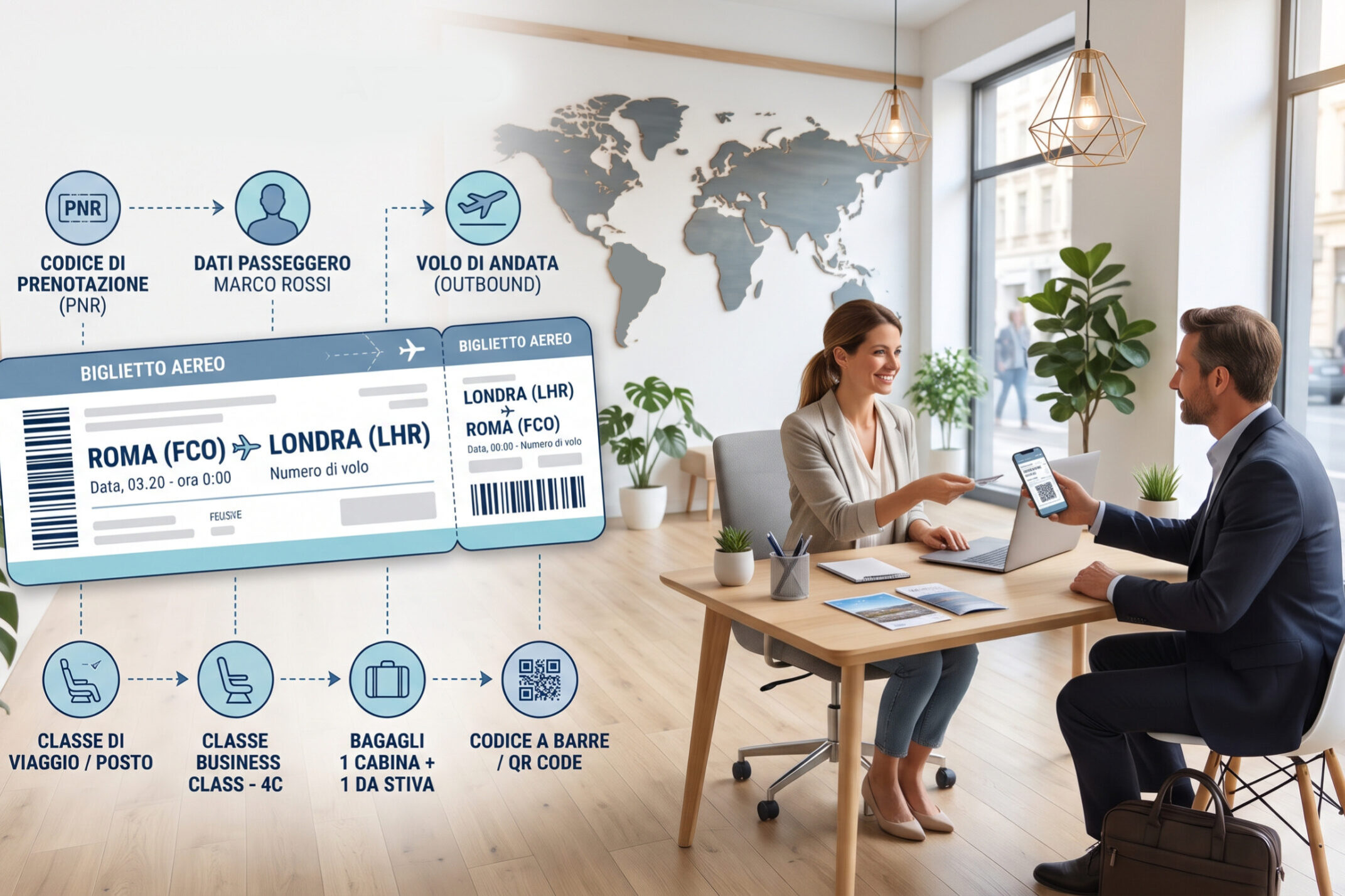
One trip, one reservation, two tickets, eight passenger segments. Different descriptions can refer to the same practice. For IATA agencies and consolidators, distinguishing these units helps them interpret a quote, verify commissions and incentives, manage changes, and compare GDS and NDC offers.
The number of segments describes the structure of the trip. Their economic impact, however, depends on fares, distribution channels, and contracts.
Segments, PNRs, and Tickets: What Are We Counting?
Two adults book a Milan–Frankfurt–New York flight, returning on the same route. Each passenger has four segments: two outbound and two return. This represents a total of eight passenger segments. The ticket can be contained in a single PNR and, in the simplest scenario, issued with two individual tickets.
The PNR keep the reservation; electronic ticket documenta il trasporto emesso e comprende i coupon associati ai voli. Prenotazione confermata ed emissione sono passaggi distinti, anche quando avvengono nello stesso processo. Source: Travelport.
When calculating, it is also necessary to distinguish between the booked segment and the leg Operational: the route between two airports can be represented differently in commercial systems. A direct flight, for example, may include an intermediate stopover.
For commissions and incentives, you must specify whether you are counting reservations, tickets, coupons, passenger segments, or segments recognized by the contract. The lines in the PNR do not automatically match the remunerative units.
Why more segments can cost less
A company sells a connection between origin and destination in a given market. Competition, demand, availability, and fare conditions affect the price: four segments don't necessarily cost twice as much as two.
Milan–Frankfurt–New York can therefore be less expensive than Frankfurt–New York alone. Even a fare component, the make component, can cover multiple segments. The price of the trip does not necessarily result from adding separate fares for each flight. Source: IATA.
Cabin, booking class and fare family are equally important: two Economy offers can include very different baggage allowances, changes and refunds.
Connected segments and coupons to be used in sequence
With the married segmentsAvailability is managed for the entire connection. Changing one route may require changes to the others as well. Separating them to circumvent airline controls can generate disputes and debit memos. Source: ARC.
The order in which coupons are used also matters. Intentionally skipping the first leg to board a connecting flight may compromise the validity of subsequent flights. The possibility of changing your itinerary must be verified under the applicable conditions: purchasing a longer itinerary does not automatically entitle you to use only the desired portion. Source: IATA.
Negotiated rates: the advantage must be measured
Public, private, corporate, and net rates describe commercial characteristics that may overlap. A negotiated rate may offer a discount, an agreed-upon amount, greater flexibility, or included services.
Access also depends on account codes, corporate IDs, agency authorizations, and distribution agreements. Systems can display private company, agency, and net rates depending on the source used. Source: Travelport.
"Negotiated" doesn't always mean "cheaper." You need to compare the final price, services, fees, and conditions. Furthermore, a discount on the base rate doesn't imply the same reduction on taxes, surcharges, and ancillary fees.
GDS and NDC: How Distribution Is Changing
Amadeus, Sabre, and Travelport are key players in distribution. NDC is a data exchange standard for creating and distributing airline offers. A GDS can also distribute NDC content: the two acronyms identify different concepts. Source: IATA.
The channel can influence content, pricing, and subsequent management. Before purchasing, you need to know who can modify, reissue, or refund the offer.
Even the absence of surcharges is not automatic: the Lufthansa Group guide valid from January 2026 also includes charges in the NDC Public model through GDS aggregators. Source: Lufthansa Group.
Do ancillary businesses increase segments?
Baggage, seat, priority, and lounges increase the cost when purchased. The application varies: a seat can be for a single flight, while a bag can cover a connecting flight, according to the applicable rules.
Many services are documented via EMDs and associated with passengers and flights. An additional EMD does not create an additional flight segment. Source: Travelport.
For commissions, incentives and corporate objectives, the contract is authoritative: ancillary costs are not automatically included in the recognized expenditure.
Five ways to contain segments
The first three strategies reduce flight routes; the last two limit unnecessary registrations and potential charges.
- Compare nonstop flights. In our example, a Milan–New York flight without connections reduces the round-trip journey from four to two segments per passenger. The ticket may cost more, but you need to factor in time, assistance, fees, and any services purchased on the different flights.
- Consider a land connection to the airport. A train or transfer can replace an approach route. However, ground costs, time margins, and connection protection must be factored in. Furthermore, in intermodal products, the rail route can be registered as a segment: the contractual treatment must be verified.
- Design multi-destination and open-jaw itineraries. To visit Paris and Brussels, it can be convenient to arrive in Paris, travel by train, and depart from Brussels. This avoids intermediate flights or unnecessary returns to the starting airport. The convenience depends on the fare combinations and the overall cost.
- Use shopping to compare, avoiding speculative bookings. Blocking many alternatives produces segments that then have to be deleted. Repeated bookings and cancellations to extend an option can also create churningQuotes and comparisons should precede confirmation of the itinerary. Source: Delta.
- Avoid duplicate passives and manage inactive ones. Don't automatically recreate in the GDS what has already been purchased elsewhere. Use permitted import and reporting methods, removing inactive segments within the required timeframes. Delta, for example, prohibits passive segments created solely to produce itineraries or invoices. This rule must be checked for each carrier. Source: Delta.
FAQ
How can we contain unnecessary segments and recordings?
To reduce air travel, you can compare non-stop flights, replace some connections with trains or plan multi-destination itineraries. open jaw, arriving in one city and departing from another. Operationally, it's a good idea to compare alternatives before booking, avoid speculative bookings and unauthorized duplicates, and remove inactive segments within the allotted timeframes.
Do baggage, seats, and other additional services increase the number of segments?
No. Additional services may increase the price of the trip, but they do not create new flight segments. Issuing an EMD for a service also does not add a new segment. Their inclusion in the calculation of commissions, incentives, or commercial targets depends on the applicable contract.
Can I skip a flight and only use subsequent flights?
This should not be taken for granted. Ticket coupons must be used in the correct sequence and according to the conditions provided: skipping the first leg may compromise the validity of subsequent legs. Furthermore, on connections managed as married segmentsChanging a segment may require changes to the entire itinerary. Therefore, any changes should be verified before departure.
Does a trip with fewer segments always cost less?
No. The price depends on demand, competition, availability, and fare conditions: a connecting itinerary can cost less than a non-stop flight. To evaluate the value, you need to compare the total cost, including baggage, additional services, fees, transfers, and flexibility. Even a negotiated fare isn't automatically the cheapest.
What is an air segment and how is it counted?
A flight segment identifies a portion of the booked itinerary. A trip from Milan to Frankfurt to New York, with a return trip on the same route, includes four segments per passenger. For two people, this means eight passenger segments, even if the booking is contained in a single PNR. Segments, reservations, and tickets are different units and should not be confused.
Savings are measured across the entire operation
Reducing segments can simplify travel and the agency's work, but it doesn't guarantee the lowest rate. The comparison should include transportation, extras, commissions, transfers, flexibility, and disruption management.
An itinerary with fewer legs may be more efficient; one with connections may be more economically advantageous. For agencies and consolidators, the best choice comes from a joint assessment of the cost to the customer, the margin, and the effort required to assist them.
Sources
- Travelport — Reservations, tariff types, ancillary services and EMD.
- IATA — Using flight coupons And NDC standard.
- ARC — Reasons for debit memos.
- Lufthansa Group — Guida ai supplementi distributivi DCC, gennaio 2026.
- Delta Air Lines — Definitions of booking practices And GDS booking rules.
By Daniele Di Stefano and Guido Deiana
