












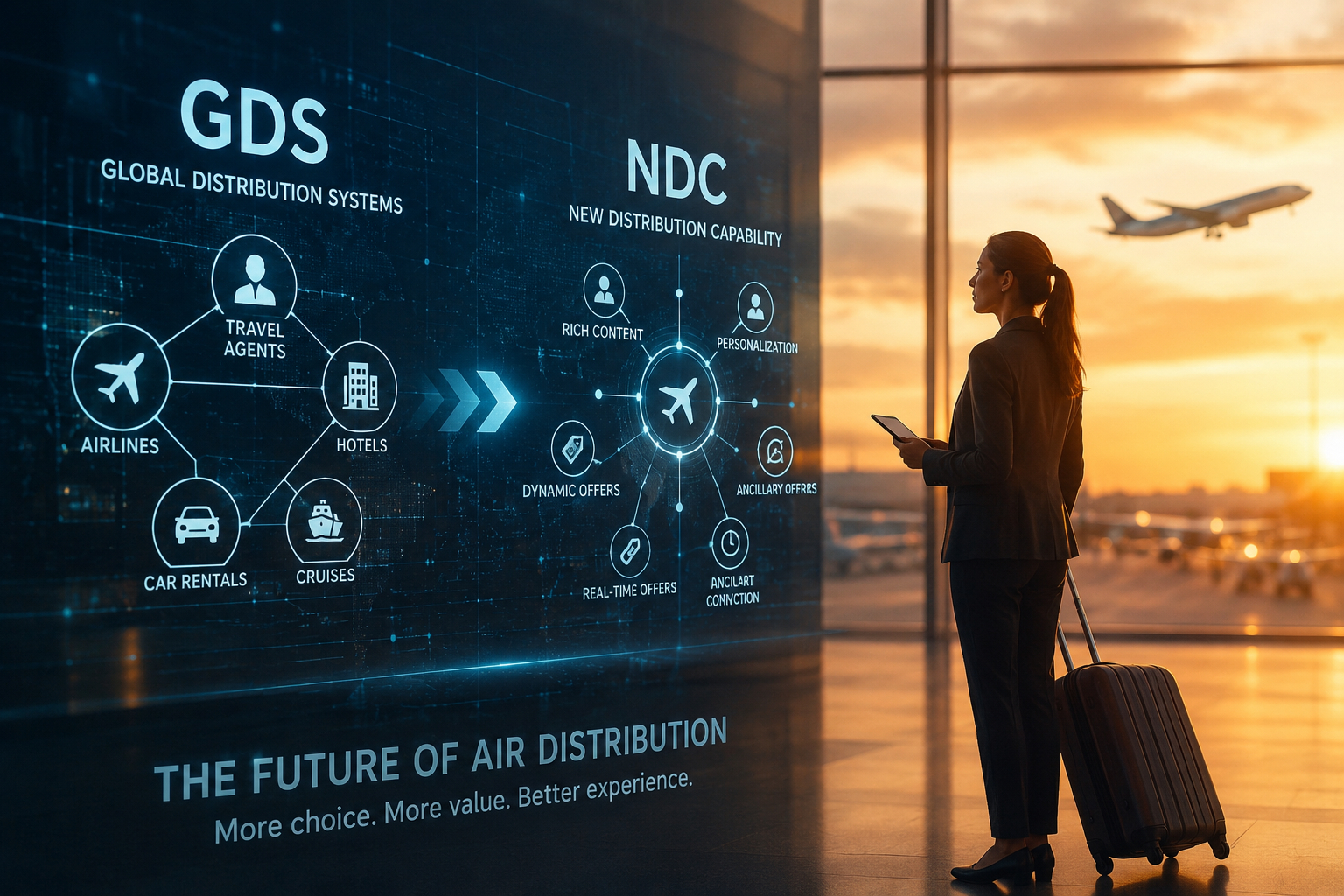
Airline distribution is undergoing a transformation that is more profound than the simple introduction of a new fare channel. GDS and NDC no longer represent two necessarily alternative models: they are becoming complementary components of an ecosystem in which traditional content, dynamic offers, ancillary services, low-cost airlines and different payment systems must coexist within the same operational process.
For travel agencies, the central issue will not be choosing between GDS and NDC. It will be being able to manage content from different sources without multiplying platforms, procedures and operating costs.
The GDS doesn't disappear: it changes its function
For decades, Global Distribution Systems have been the primary infrastructure used by agencies, consolidators, and travel management companies to check availability, compare fares, create PNRs, and issue tickets.
Their value lay in their ability to standardize and aggregate the offerings of hundreds of airlines within a single operating environment.
The introduction of NDC has highlighted some of the limitations of the traditional model: the rigidity of fare classes, the difficulty of presenting visual content, the limited management of ancillary services, and the difference between the offers available on company websites and those distributed through the agency channel.
The main GDSs are responding by progressively transforming into multi-source retail platformsAmadeus, Sabre, and Travelport are integrating EDIFACT, NDC, and Low Cost content to offer agencies a single environment for research, comparison, booking, and post-sales support.
The GDS of the future will therefore be less like a centralized tariff archive and closer to a orchestrator of contents, offers and services.
NDC evolves from a distribution channel to a commercial infrastructure
NDC, New Distribution Capability, is a standard developed by IATA to enable airlines to create and distribute more complex, flexible and relevant offers for the traveler.
Through NDC, an airline can offer dedicated fares, baggage allowances, seat selection, lounge access, priority boarding, and other services more comprehensively than with traditional systems.
The decisive step concerns the possibility of producing dynamic offersThe price can be constructed in relation to demand, availability, distribution channel and the chosen product combination.
This evolution includes the continuous pricing, which overcomes the rigidity of a limited number of tariff levels, and the dynamic bundling, through which flights and services can be combined with greater flexibility.
For the customer, this means a wider choice. For the agency, it means having to evaluate offers that can no longer be compared based on ticket price alone.
Travelport and multi-source aggregation
Travelport represents one of the most significant examples of the transformation of the GDS into a modern travel retailing platform.
Through Travelport+The company aims to bring together traditional airline content, NDC offers, low-cost airlines, and ancillary services in a single environment. The goal is to allow agents to view and compare different sources without having to constantly switch between systems.
The main problem with multisource distribution, in fact, is not just access to the contents. It is their normalization.
NDC offers can be structured and presented differently by each company. If the system simply aggregates them without making them comparable, the agency receives more content but also greater complexity.
To address this problem, Travelport has developed the Content Curation Layer, an artificial intelligence and machine learning-based component that aggregates, normalizes, and sorts results from different sources.
The aim is to make it easier to understand the true value of each offer by consistently displaying rates, conditions, included and ancillary services.
Travelport describes this evolution as the move from simple aggregation to content curation: the system does not just return a long sequence of results, but tries to select and organize the most relevant ones.
Comparability becomes a strategic function
With the rise of dynamic pricing and additional services, two seemingly similar offers can have very different characteristics.
A cheaper fare may not include baggage, seat selection, or the option to change tickets. A more expensive offer, however, may be more convenient overall.
Travelport+, like evolving competing platforms, aims to make these differences visible within a single search flow.
The ability to show NDC and traditional content side by side It therefore takes on central importance. For an agency, value doesn't come from the sheer number of available rates, but from the ability to quickly understand which solution best meets the client's needs.
Future distribution will require a real commercial comparability, beyond simple technical connectivity.
The real test will be the servicing
Having a competitive rate is only the first step. An agency must be able to modify a booking, add services, manage cancellations, refunds, schedule changes, and re-routing.
Early NDC implementations often featured varying levels of after-sales support. Some content could be booked but not modified as easily as traditional tickets.
Travelport is progressively extending the functionality of servicing NDC on the companies integrated into the platform. For some carriers, agencies can already search, compare, book, and manage NDC offers within the same environment.
The availability of individual functions, however, continues to depend on the company, the market and the level of integration achieved.
The future value of a platform will not be measured solely by the number of connected NDC companies. What will count is the completeness of servicing, reliability of post-sale operations and continuity between booking, payment and issuance.
Skytool: un’unica interfaccia per GDS, NDC e contenuti multisorgente
In this scenario, Skytool svolge una funzione di integrazione e semplificazione operativa, providing agencies with content from their GDS, NDC connections, and low-cost aggregators through a single interface. The goal is to avoid operators having to constantly switch between different environments, repeat the same searches, or manage separate procedures for each source. Through a single workspace, agencies can check availability, compare offers, verify included services, create bookings, and manage operational flows while maintaining control of their PCC, rates, and applicable commercial rules. Skytool non sostituisce il GDS né gli accordi già esistenti, but it makes them more accessible and manageable, transforming a plurality of systems into a more streamlined operational experience. For IATA agencies, sub-agency networks, and corporate clients, this means having everything at your fingertips, with greater speed, less technical complexity and a unified vision of the entire booking and issuing process.
From PNR to order
The transformation envisaged by IATA goes beyond NDC. The program Modern Airline Retailing is aiming for a system based on Offers and Orders.
In the current model, a reservation can be distributed between the PNR, the electronic ticket, the EMD for ancillary services, and various administrative records.
With ONE Order, these elements should gradually flow into a single digital order. The principle is similar to e-commerce: the customer purchases a combination of products and services, while the system maintains a single record of the order, payments, changes, and purchased services.
The market will undergo a long hybrid phase. Traditional systems will continue to coexist with new architectures, as complex processes such as line management, accounting, airport management, operational irregularities, and settlement will need to be integrated.
Artificial intelligence and supply control
Artificial intelligence will play a growing role in offer analysis. It will be able to filter billions of combinations, identify relevant results, recognize preferences, and assist operators in their decisions.
Travelport’s Content Curation Layer advances this direction, using AI and machine learning to organize content from NDC, traditional distribution, and other sources.
This evolution also introduces a transparency issue. The agency must be able to understand why an offer is favored, what conditions it includes, and what criteria were used to order it.
AI will be truly useful when it reduces complexity while maintaining control, readability and decision-making autonomy.
The new role of agencies
The multiplication of offers makes professional advice more important.
The agent will have to evolve from a tariff intermediary to interpreter of commercial complexity, capable of comparing the overall cost of the trip, evaluating conditions and combining products from different sources.
Advanced GDSs, platforms like Travelport+, and NDC aggregation systems can make this work more efficient, but they don't eliminate the agency's role. On the contrary, they enhance the value of those who know how to use technology to select, explain, and manage offers.
The future will be multi-source
In the next market they will continue to coexist EDIFACT, NDC, low-cost airlines, private fares and direct agreements.
An agency's competitiveness will depend on its ability to access these sources through a coherent operational workflow. The most effective platforms will be those capable of aggregating, standardizing, comparing, and managing content even after booking.
Travelport, Amadeus, and Sabre are moving into this new competitive space, where the value of the GDS will depend less and less on fare availability alone and more and more on the ability to orchestrate the entire supply cycle.
Preparing for the market to come
Agencies can start by evaluating NDC coverage from leading providers in their market, available servicing capabilities, content comparability, integration with back offices and payment systems, and agent training.
Technology alone doesn't create competitive advantage. The outcome depends on how it's integrated into business and organizational processes and on the agency's ability to transform technological complexity into a simple, consistent, and controllable work experience.
In this perspective, Skytool può rappresentare il punto di accesso operativo alla nuova distribuzione aerea, bringing together content from the GDS, NDC connections, and low-cost aggregators in a single interface. The agency can thus search, compare, and manage offers from different sources without having to multiply work environments, procedures, and tools.
Skytool non sostituisce il GDS né modifica gli accordi commerciali già esistenti. Integrates with agency infrastructure, making content, services and processes more accessible and keeping the PCC, fares, issuance, markups, payments and network authorizations under the control of the IATA structure.
The future of airline ticketing won't be determined by NDC's victory over GDSs. It will arise from their convergence into a new retail infrastructure, where offers, services, and payments can be searched and managed as part of a single digital order.
In questo passaggio, piattaforme come Skytool avranno il compito di translating technological convergence into operational simplicity, putting everything at your fingertips through a single environment and also allowing sub-agencies and corporate clients to access services according to the rules, permits and conditions established by the Master Agency.
The market will reward agencies capable of combining breadth of content, operational simplicity, quality of servicing and distribution control. Travelport e gli altri GDS continueranno ad avere un ruolo centrale, trasformandosi da sistemi di prenotazione a piattaforme intelligenti per il commercio dei viaggi, mentre Skytool permetterà alle agenzie di utilizzare questa evoluzione all’interno di un processo più semplice, integrato e governabile.
By Guido Deiana and Daniele Di Stefano