












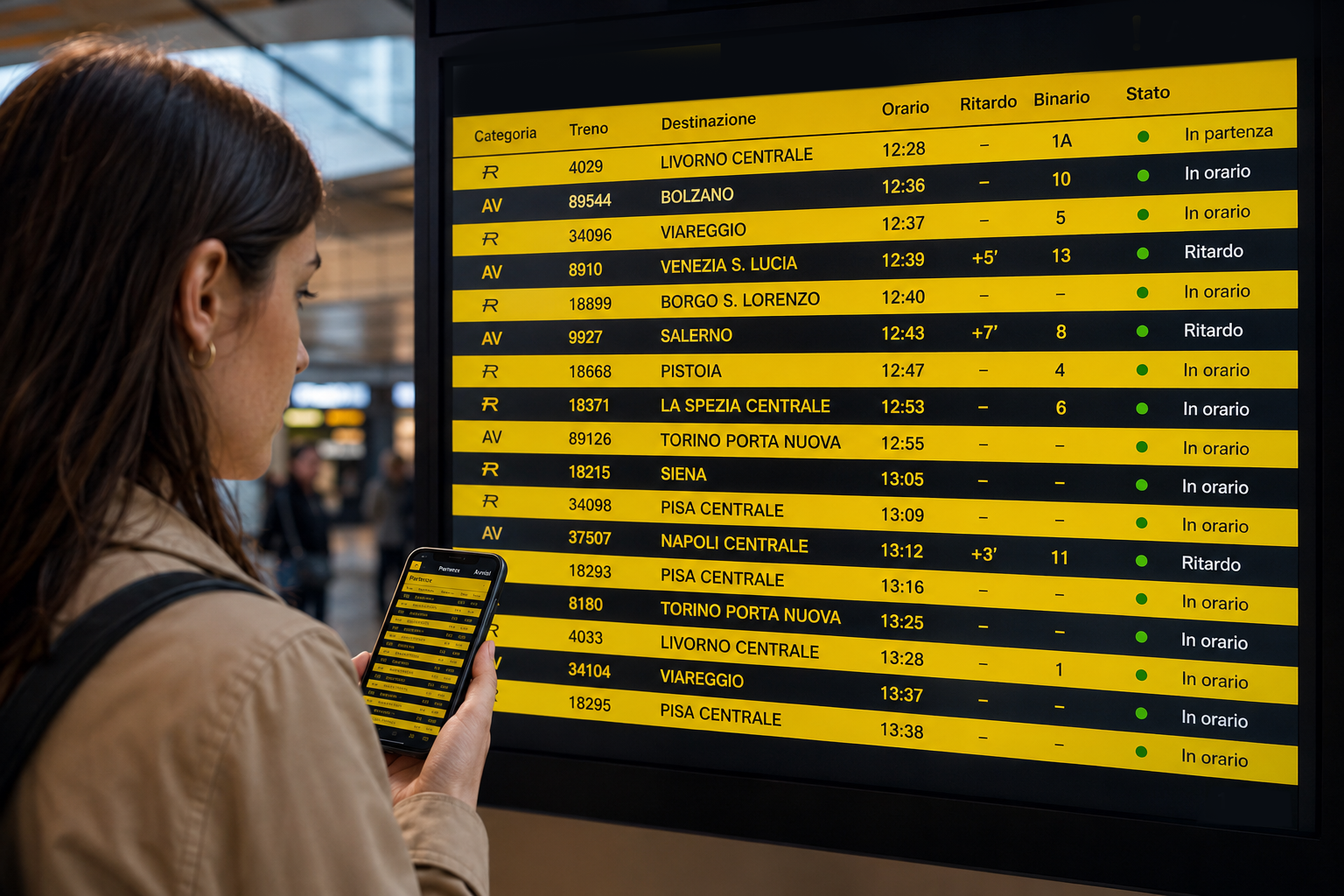
The fastest system
You don't always have to be standing in front of the large station display to find out which platform a train will depart from. You can also check the train schedule on your smartphone, either before arriving at the station or while moving from one platform to another.
The quickest way is to open Google and type:
display + station name
For example:
- Roma Termini Information Board
- Milano Centrale Departure Board
- Florence Santa Maria Novella Departure Board
- Bologna Centrale Departure Board
- Napoli Centrale Departure Board
You can also use more specific search terms:
- Departures from Rome Termini
- Arrivals at Milan Central Station
- train platform at Florence Santa Maria Novella
- Trains departing from Bologna Centrale
- Trains Arriving at Napoli Centrale
- RFI Venice Santa Lucia Schedule Board
The results should include the RFI Live Arrivals and Departures Monitor, the official service that displays much of the information shown on the station monitors on the phone screen.
What information does the online train schedule display?
The RFI monitor allows you to view the sections separately Departures e Arrivals and generally refers to:
- train number;
- category and operator;
- destination or origin station;
- scheduled time;
- any delay;
- expected track;
- departure or arrival state;
- subsequent stops;
- any service-related announcements.
The train number is particularly important. At a large station, there may be several trains heading to the same city within a short time frame; therefore, simply checking the destination may not be enough.
RFI notes that the online monitor provides information on trains arriving at and departing from its stations, but also warns that the data displayed on the website may be delayed by up to approximately three minutes compared to the announcements made at the station. Additionally, the page must be refreshed by clicking the appropriate icon. The audio announcements and monitors at the station therefore remain the final authority.
When Is It Useful to Check the Scoreboard on Your Phone?
When you have little time to change trains
During a tight connection, knowing in advance which platform your train will arrive at and which platform your next train will depart from can help you find your way more quickly.
As the first train pulls into the station, you can look for the transfer station display board and open the section Departures and identify the second train by its number.
The platform number may be announced or changed even just a few minutes before departure. For this reason, it’s a good idea to refresh the page once you get off the train and keep listening to the station announcements.
When the train is late
The online schedule lets you check whether the delay is increasing, decreasing, or remaining the same. This information can be helpful in deciding:
- when to go to the platform;
- whether to wait at the station;
- whether to let the people waiting for us know;
- whether to look for an alternative solution;
- whether a coincidence is still plausible;
- whether to consider taking the next train.
When you need to check a single train, it is best to search for it through the train number, which identifies the trip more accurately than the destination alone.
When someone comes to pick us up at the station
Anyone picking up a traveler should not check the departures board, but rather the arrivals.
All you have to do is search for, for example:
Arrivals at Florence Santa Maria Novella
or open the station monitor and select the tab Arrivals.
You can check the scheduled departure time, any delays, and, when available, the arrival track. This way, family members, friends, taxi drivers, private chauffeurs, or hotel shuttle drivers can avoid unnecessary waiting and arrive at the station at the most convenient time.
When you have to meet someone at a large train station
Stations such as Roma Termini, Milano Centrale, Bologna Centrale, and Torino Porta Nuova have numerous tracks, entrances, and waiting areas.
Knowing the track number helps you determine a more precise meeting spot. However, it’s best not to base your meeting spot solely on this information, because the track number can change. A fixed location, such as a ticket office, an entrance, or a store, is often a safer choice.
When the station monitor is far away or hard to see
At small stations, the display may be located only near the entrance, while the passenger may already be on the platform or in a different waiting area.
In these cases, the phone acts as a second screen, which is especially useful when you can't hear the announcements clearly or when the physical display is temporarily out of service.
When traveling with children or a lot of luggage
Knowing which part of the station to head to helps you plan your route more effectively, especially when you're traveling with heavy luggage, strollers, or small children.
At a large station, some platforms may require the use of underpasses, escalators, or elevators. Checking the departure board in advance does not eliminate the need to listen for announcements, but it can reduce the need for last-minute changes in your route.
When you have limited mobility
Checking the route in advance can also be helpful for people with mobility challenges, as it allows them to locate elevators, ramps, and accessible paths at a more leisurely pace.
However, online information should not replace instructions from rail staff or pre-booked assistance services: a change in platform may require you to quickly adjust your route.
When the station is very crowded
On holidays, during strikes, at events, or during rush hour, it can be difficult to get close to the main screens. Checking the schedule on your phone lets you stay in a less crowded area and check multiple departures at the same time.
However, it's important not to completely cut yourself off from the world with headphones or earbuds, because announcements may include updates that haven't yet appeared online.
When You Miss a Connection
After missing a connection, the departure board lets you quickly see which other trains are leaving for the same destination.
Before boarding a different train, however, you must check whether your ticket is valid, can be modified, or can be used on that specific route.
When you're still at the hotel, at the office, or at home
You can check the departure board before heading to the station. If the train is already significantly delayed, you can better plan your connection while still allowing for a safe buffer: a delay may actually shorten, and the estimated arrival time may change.
How to Use RFI's Arrivals and Departures Monitor
The procedure does not necessarily require installing an app:
- open Google or another search engine;
- type scoreboard followed by the station's full name;
- Open the results for RFI's Live Arrivals and Departures Monitor;
- choose between Departures e Arrivals;
- look up your train number;
- check the schedule, delays, platform, and announcements;
- Press the refresh button periodically.
To find the correct station more easily, it’s best to use the full name of the train station. Simply typing “Venice,” “Rome,” or “Milan” might not be enough, because there may be several stations in the same city.
So it's better to search for:
- Venice Santa Lucia;
- Rome Termini;
- Rome Tiburtina;
- Milan Central Station;
- Milan, Porta Garibaldi;
- Florence, Santa Maria Novella;
- Genoa, Piazza Principe;
- Turin, Porta Nuova.
Check your train with ViaggiaTreno
ViaggiaTreno is Trenitalia’s service dedicated to providing information on train schedules.
You can use your phone to check the train's route, arrival and departure times, scheduled stops, and information regarding service disruptions, cancellations, or substitute services.
ViaggiaTreno is especially useful when you want to track a train running on schedule along its route, whereas the RFI monitor provides a more immediate overview when you want to see all the departures or arrivals at a station.
Check the Italo train schedule
For Italo connections, you can use the service Italo on the Road.
The “Real-Time Stations” section allows you to search for a station and view departing and arriving Italo trains, with information on scheduled departure times, actual departure times, delays, and platform numbers, when available.
The Italo app can also send real-time notifications about trips associated with your reservation.
To get a broader view of all the operators at an Italian station, the RFI monitor generally remains the most comprehensive starting point.
View departure times on Google Maps
Google Maps can also show train schedules.
The procedure is simple:
- Open Google Maps;
- search for the station;
- tap the station card;
- check available departures;
- Click the link below for more details.
Google notes that some stations display real-time information, while others show only scheduled times. Colors and symbols may indicate whether a train is on time, early, or late, but the availability of this data varies by station and transit agency.
Google Maps is therefore very useful for planning the entire route to the station and comparing departure times, but when you need immediate confirmation about the platform and train service, it’s a good idea to also check the official RFI display or the operator’s channel.
Is it possible to view the scoreboard without downloading an app?
Yes. The easiest way is to use your phone's browser and search for:
display board + station name
RFI's Live Arrivals and Departures Monitor operates via a web page and does not necessarily require registration or installation.
If you frequently use the same station, you can bookmark the page or add a shortcut to your phone's home screen. That way, you can open the schedule with just one tap.
How to Read the Scoreboard Correctly
To avoid mistakes, you need to check at least four things:
Train Number
It is the most accurate piece of information for identifying the race.
Scheduled Times
This is the originally scheduled time, and it remains the time used to list the train.
Delay or estimated time
Indicates the deviation from the scheduled time.
Track
It can only appear near the beginning and can be edited even after it has been published for the first time.
The destination alone isn't always enough. A train may also be announced with its final destination, which is different from the city where the passenger needs to get off.
Can the track displayed on the phone change?
Yes. The track may be changed due to traffic conditions, delays, right-of-way priorities, breakdowns, or operational changes.
For this reason, it is advisable to:
- refresh the page;
- Check the information again when you arrive at the station;
- monitor the physical monitors;
- listen to the announcements;
- Do not stray too far from the path leading to the tracks;
- Always check the train number.
The scoreboard on your phone is a very useful tool, but it shouldn't be considered set in stone.
What is the fastest method?
For occasional use, the fastest method is:
Google → “departure board + station name” → RFI Monitor → Departures or Arrivals
To track a specific train, you can use the following:
- the train number on ViaggiaTreno;
- the "Infomobilità" section of the Trenitalia app;
- Italo in Viaggio for Italo trains;
- the station's listing on Google Maps.
A small habit that can make your trip easier
The train schedule on your phone doesn't replace the one at the station—it just gives you a heads-up.
It helps you figure out where to go, coordinate a connection, let those waiting for you know, and respond more quickly to delays or changes. All it takes is a few seconds and a very simple search:
display + station name
Saving this procedure can be especially helpful when time is short and every minute counts.